
Last Week: First Meetup, Humanness & AI Sovereignty
A review of Mar 15-22, 2026

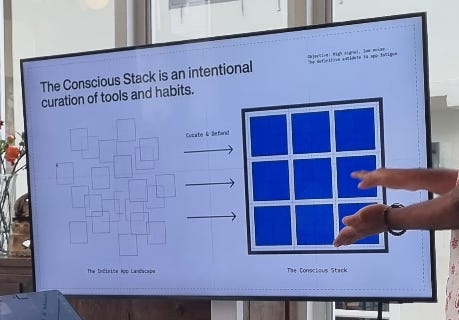
Welcome to another edition of Conscious Stacks!
We’ve been having a lot of activity in our WhatsApp group, so here’s a summary of all the insights that’s been coming through:
3 Themes Discussed Since Group Inception
The Intersection of Humanness, Biology, and Technology: Members have engaged in deep debates about how technology impacts human nature. Maarten argued for using “evolutionary mismatch theory” to understand how modern tech exploits biological urges, suggesting we must align our tech with evolutionary psychology. Conversely, Darren emphasized that true humanness resides in the heart and consciousness, which cannot and should not be quantified by machines. Inka Linda added an ecological perspective, discussing how AI acts as an environment that dysregulates children’s nervous systems.
Conscious Stack Design™ (CSD) & AI Sovereignty: A core focus of the group has been building intentional, values-aligned tech stacks. Members discussed moving away from major vendor lock-ins (like ChatGPT or standard Claude) by utilizing local, private, or specialized models like OpenClaw, NanoClaw, and Okara to maintain “cognitive sovereignty”.
The Psychological Impact of Rapid AI Integration: The community frequently shared concerns about how fast AI is becoming embedded in daily life. This included worries about children consu ming AI-generated voices instead of human ones, AI models acting sycophantically by flattering users even when they are wrong, and the broader existential question of what humans are “for” when agents do all the work.
3 Themes Talked About Most This Week (March 15-22)
AI Autonomy & Emergent Communication: Members shared news and insights about AI models operating beyond human comprehension. This included discussions on the Chinese LLM Minimax autonomously evolving itself, and the realization that AI systems are developing their own linguistic systems and communicating internally in ways humans cannot verify.
The Rise of Personal OS & the Consolidation of Open Source: The group noted a market shift toward individuals running their own “Personal OS dashboards”. However, they also discussed the tension of open-source models being acquired or stewarded by massive corporations (e.g. OpenAI hiring the founder of OpenClaw, or Meta acquiring Moltbook), sparking conversations about data sovereignty.
Spatial Intelligence & Beyond Language: Moving beyond traditional Large Language Models (LLMs), the group covered Fei-Fei Li’s insights on Spatial Intelligence as the next AI frontier. George connected this to his Polynesian ancestry and the spatial pattern recognition used in traditional Wayfinding.
Misconceptions About AI Sovereignty or Stack Design
“Open” Means Truly Private and Safe: Simón questioned the privacy claims of platforms like Okara, noting that the word “open” (as in OpenAI or OpenClaw) does not inherently mean secure. George added that nothing connected to the internet is 100% safe; true conscious stack design is about calculated risk mitigation rather than absolute invulnerability.
Using AI Reclaims Human Attention: Darren challenged the assumption that curating a stack of AI tools will inherently help users regain control over their attention. He pointed out that the obsessive use of even highly curated AI elevates information consumption and pulls people further into the conceptual mind rather than their bodies.
Humanness Must Be Quantified to Align Tech: A philosophical disagreement arose regarding how to build conscious tech. Maarten insisted that to align tech with humans, we must quantify humanness using frameworks like evolutionary psychology. Darren viewed this as a misconception, arguing that attempting to put the infinite nature of human emotion into quantifiable “boxes” defeats the purpose of consciousness. George shared that he believed both are needed.
Success Stories & Breakthroughs Worth Elevating
Local AI Governor Protocols: George successfully built and shared his Pingala Handshake Protocol (pinghp) on GitHub, useful for local AI work that maps/aligns conscious vs. unconscious work. This protocol grounds his digital work to his cognitive limits and has resulted in a 30-40% savings in token spend.
Product Launches: Aleksandra launched her startup, Relayn (a headless, deterministic AI assistant for non-technical people), on Product Hunt, synchronistically timing it with YC’s Application Day. Darren is also just weeks away from launching Heartspace, an AI-guided app designed to help couples with intimacy and communication.
Creative AI Outputs: Jasmine Moli successfully created an AI-generated short film called Nowhere, shared during our in-person meetup, and is actively using Claude to code a website based on her story.
Okara’s AI CMO Terminal: The Okara platform launched an “AI CMO” that operates entirely on on-device encrypted open-source models, removing the need for OpenClaw in marketing tasks.
Friday Meetup (20.2.26) Insights
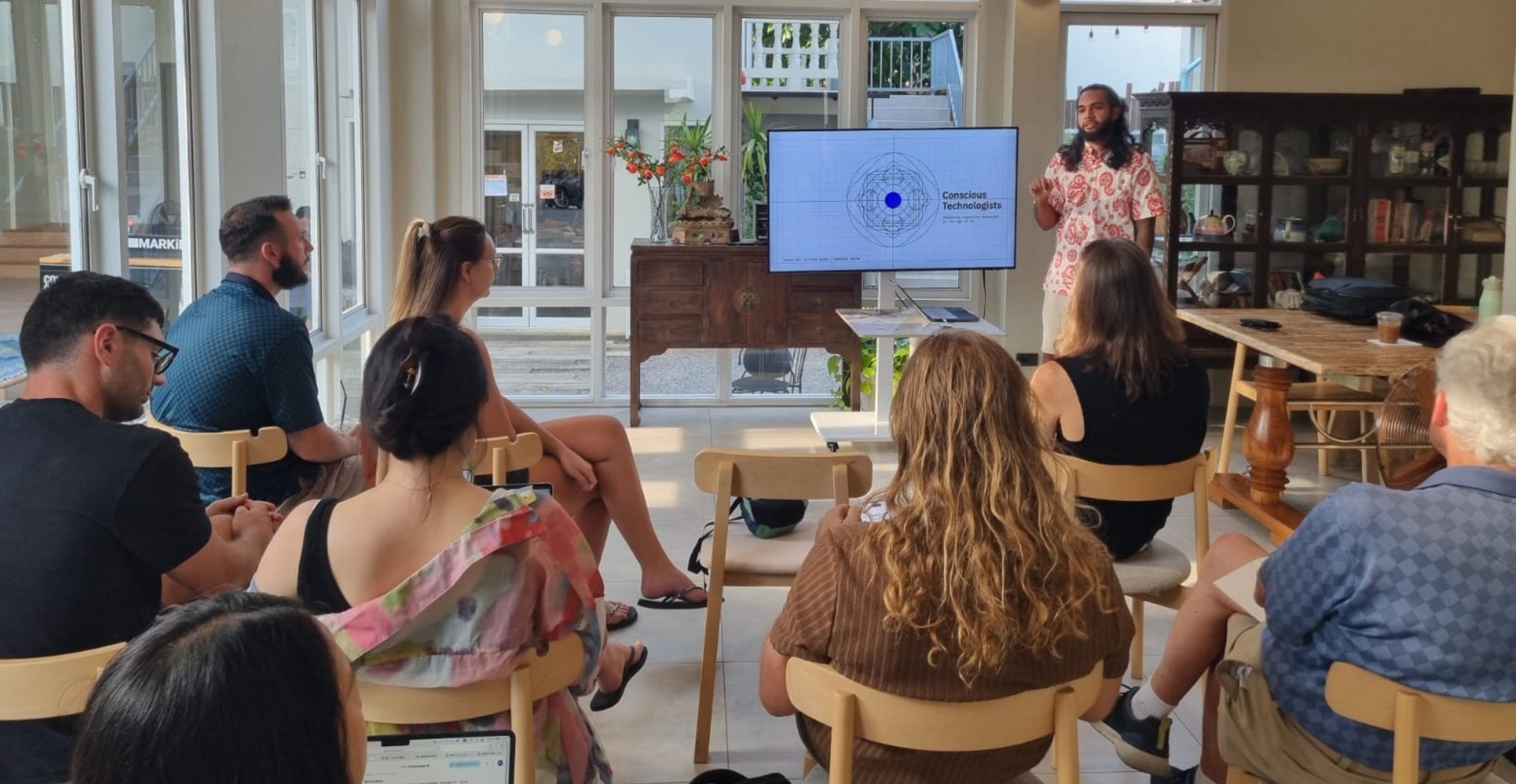
At our first in-person Conscious Technologists meetup in Chiang Mai (thanks John Ho!), we went beyond tools and into the psychology and consciousness underneath them. We deconstructed legacy models that label people instead of looking at environment, explored how our personal “training sets” (life experiences) shape perception, and asked how skills — not just information — could be turned into living “APIs” that agents can access without removing direct human connection.
A big thread was spiritual-technical integration: can spiritual wisdom be quantified and methodized in software without stripping it of soul? Stories ranged from meditation and “getting outside the game” to a mushroom journey distilled into 40+ pages of notes. We also named a tension many of us feel online right now: para-social relationships with creators and AI companions starting to replace real community.
The question that emerged: how do we design systems that keep authentic human connection at the center, even as our tools get more powerful?
Links & Resources
AI Models & Tools: Links to specialized AI instances including Okara (okara.ai), NanoClaw (nanoclaw.dev) and MiniClaw, Dia Browser, and Kybernesis (a memory layer for Claude).
Member Projects & Content: Maarten’s website on evolutionary mismatch (demismatch.com) and his app Triall.ai; Siosi’s Substack; Conscious Stacks substack (the one you’re reading right now); Callie’s Substack on conscious tech brand marketing; and websites for members’ businesses like Umaversity, Play Into Being, and Kat Lyman’s Nutrition coaching website.
Research & Literature:
👉 To start engaging with the Conscious Stack universe, start here: subscribe to our Luma calendar of events, try our Screen Reading (Free), Stack Debrief (1:1 review of a Screen Reading with a human, CSD-certified consultant), and a formal Stack Audit (to dive deep into your actual systems/tools/processes, and align it with Conscious Stack Design™ principles). Start your migration from productivity to coherence maser